If a week is a long time in politics, what is a decade in Brexit? It has now been 10 especially long years since Britain voted to leave the European Union, an act that began a process of departure that took several years to formally complete and is arguably still ongoing. The issue’s divisiveness is so potent that some may not yet be ready to reflect on it as history. But Anthony Seldon’s The Brexit Effect: 2016-2026, an edited collection of essays published to mark the 10-year anniversary, is in my view a timely book. For those who can bring themselves to step back into those tumultuous times, it provides an important service.
On the Strand Group’s MA government studies at King’s College London, I teach the Conservative years (2010-24) as ultra-contemporary history, so perhaps my stance on the book’s value is not a surprise. Consisting of 36 chapters written by a broad range of well-placed insiders and expert outsiders, The Brexit Effect offers reflections on the referendum and the withdrawal negotiations that followed, as well as analysis of the legacy of the UK’s departure from the EU and some ambitions for the future. It features political participants from both the leave and remain sides, as well as the views of senior civil servants and analysis by other impartial observers.
Whilst Britain’s relationship with the EU is far from resolved, there is still a great deal to be gained from stepping back and reflecting on the process to date, even at this juncture. There are lessons to be captured and deep questions to be asked about our institutions and our politics. Lord Simon Case’s chapter notes that the use of “S” (strategy) and “O” (operations) committees to manage Brexit was a machinery of government technique deemed successful enough to be recreated during the Covid-19 pandemic.
There will be many more lessons, whether for campaigning or managing and delivering change through government, that may otherwise be lost but for works of contemporary history such as the practitioner-authored chapters of this book. It may not amount to the final or definitive draft of the history of Brexit, but it will surely be cited in it when the dust finally settles, if it ever does.
The diversity of viewpoints is one strength, but the number of different topics and angles discussed by the expert contributors further reflects just how complex the question of leaving the European Union really was. There are chapters exploring politics, economics, psephology, international relations, science and innovation and neuroscience.
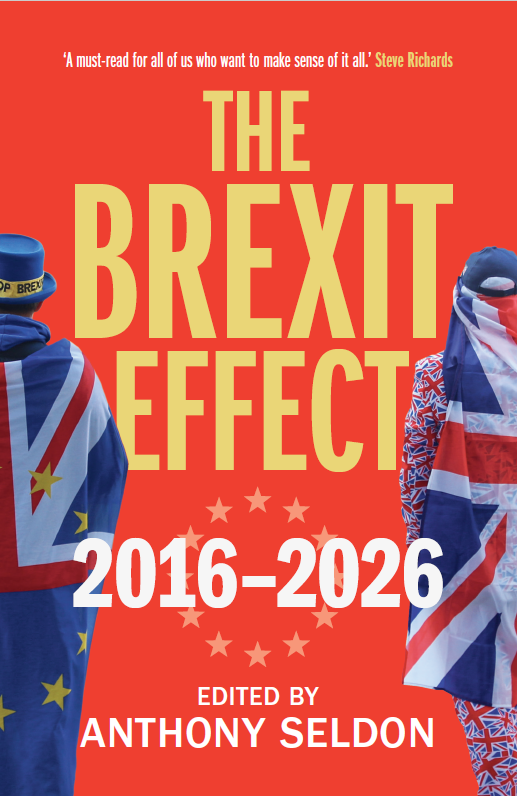
❱ The Brexit Effect: 2016-2026
❱ Edited by Anthony Seldon
❱ Publisher: Cambridge University Press
Writing styles vary, from Douglas Carswell’s short, punchy paragraphs to the slightly more difficult to digest (to this historian) economic modelling in Patrick Minford and Zheyi Zhu’s chapter. There is some repetition across chapters, with several contributors providing their version of the pre-history leading up to the referendum, for example. However, it is fascinating to observe how different moments and factors are highlighted by remain and leave-inclined authors, further demonstrating how many contrasting interpretations can exist of what is, in theory, the same shared history. Additionally, whilst the book does work if read cover to cover, the repetition can mean that individual chapters stand alone and can be read independently.
Civil servants will surely be interested to read the chapters written by their former peers. Readers may not expect Simon Case’s chapter to open with a quotation from Lenin (on the nature of revolutions), but it goes on to provide a masterful yet detached historical sweep of the Brexit process. Helen MacNamara’s chapter is more personal in tone, reflecting on the civil service’s “default remain” position and its impacts on impartiality. Simon McDonald’s chapter is comparatively bullish, explicitly defending the civil service from the accusation that it should have done more to prepare for a leave vote.
But there is also great value in reading the partisan contributions, and particularly those who were on the opposing side to the reader. The benefit of a little distance from events must surely be the potential to better comprehend why others made different choices, and the multitude of ways in which the process following the referendum could have been improved.
I would personally hope that we are not seriously considering another referendum on any big issues any time soon. But if we were to do so, or even if not, I would hope that we would heed some of the lessons provided across this book’s 36 fascinating chapters.
Dr Jack Brown is a lecturer in London studies and is part of the Strand Group in the Policy Institute at King’s College London