The world is growing more uncertain and more dangerous. Increasingly, the government must account for this uncertainty, faced with hard spending choices and greater public scrutiny as pressures mount on our critical services: rising geopolitical turmoil is fuelling a need for defence spending; our ageing population is straining the health service and our care system; and stubborn joblessness means tax receipts are shrinking, even as our welfare bill continues to rise. At the same time, threats to our security mean the need for a whole-society approach to national resilience, or preparedness for conflict, is ever more urgent, encompassing not only the military response but also how our society and our public services can continue to function amid times of crisis.
The UK Resilience Academy, run jointly by the Cabinet Office and Serco, lists three pillars which must be developed to achieve resilience: capabilities; practice; and behaviours. All three will need to be built into our critical services to ensure Britain’s civil preparedness in a world in flux.
With a clear need for swift action, business can – must – be part of the solution. Government and its private sector partners must work together to deliver the outcomes that will bolster resilience in our critical public services.
Public-private sector partnerships, when done well, are proven to result in faster delivery, greater flexibility, and stronger outcomes for citizens. The most obvious example of this came during the Covid pandemic, when the government rapidly mobilised both its own and the private sector’s resources in response to a critical need. Within four weeks, Serco mobilised over 10,000 people and stood up 20 drive-through test centres, with a daily capacity of over 20,000 tests.
Perhaps most famously, as the pandemic unfolded, the government established the Vaccine Task Force, bringing together the best of the public and private sectors. With expertise from government, business, industry and academia, the Task Force led a truly world-leading vaccination campaign: within seven months of Britain becoming the first country in the world to administer a Covid vaccine to the public, over 80% of UK adults had received at least one dose.
The pandemic showed what’s possible when we combine the public, private and third sectors, working together to create a solution and respond to an acute need.
But providers like Serco have a duty beyond assisting crisis response: the nature of today’s world means societal resilience (resilient capabilities, practice and behaviours) must be built into everything we do, from supporting local skills, communities and economic growth to designing critical services that will support citizens during times of crisis.
Developing capabilities for civil resilience begins with ensuring structures and support are in place for all members of society. For Serco, everyday civil resilience starts with opportunity and prosperity for all. That’s the logic behind our Pathways employment programme, dedicated to providing opportunities for disadvantaged groups facing structural barriers to work. Under Pathways, we’ve supported over 100 people into work since the start of the year, and over 50 people with criminal records. We additionally invest in local economies, workforces and skills: 58% of our suppliers in the UK are SMEs, and roughly 80% of our UK employees live within 25 miles of their workplace.
Capabilities are also critical to the vital work we do with governments, where we partner with our customers to operate at scale, at pace and under pressure. In defence, for instance, Serco’s world-leading services in areas such as naval autonomy, military training, and recruitment mean we are key to shoring up Britain’s sovereign capabilities in exactly the contested, in-demand domains which will be crucial to future deterrence and warfighting readiness.
But practices, another pillar in building resilience, matter just as much as capabilities. As an organisation, we also understand that the programmes and services we provide on behalf of government are crucial to Britain’s civil preparedness and cannot be allowed to be disrupted. We’re developing comprehensive plans to enhance our own organisational resilience to ensure we are able, in times of crisis, to continue delivering critical programmes and functioning public services which citizens rely on. We’re learning much, and we’re looking forward to sharing those learnings more widely to help ensure resilience practices are widely embedded across public and private sectors.
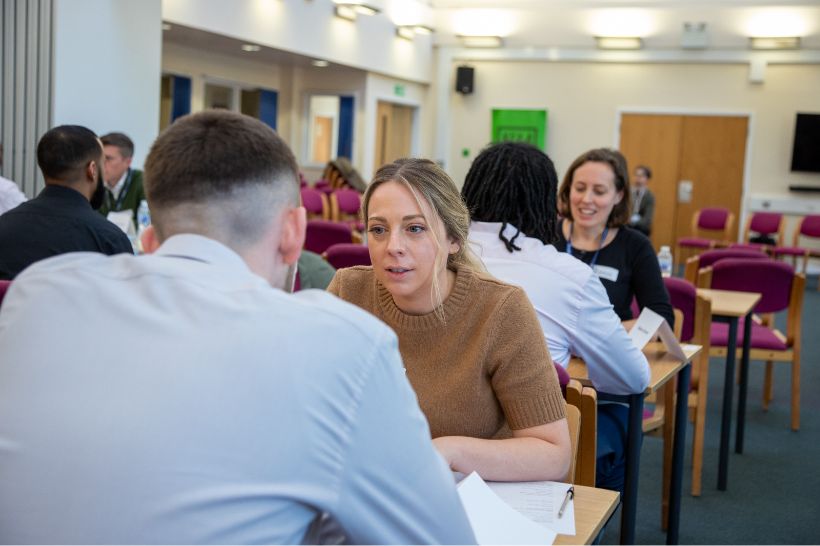 Serco colleagues hold mock interviews with prisoners at HMP Thameside as part of our Pathways employment programme
Our challenge now is how government and its partners work together to deliver more. Achieving true civil and military readiness across the whole of society will depend on the private and third sectors, stepping up and working with government, to solve societal problems together. This is where behaviours, the third pillar of resilience, comes in: developing a mindset whereby government and business see ourselves and each other as parts of one whole.
If we are to deliver on the government’s critical missions and enhance Britain’s national resilience and readiness, the public and private sectors need each other. By pooling our resources, expertise and talent, we’ll be able to collaborate earlier in policy, use operational insights to build resilience into public service design, and take a more agile approach to piloting new solutions so that we can deliver the services citizens need now. By sharing knowledge and working together, we can build whole-society resilience, rather than contract-by-contract solutions.
For those of us in the private sector, this is our moment: to show our government partners we can heed the call and respond, that we’re here to support their whole-society approach. The services we provide at Serco are almost unparallelled in their breadth and their scope, but what unites our 30,000-strong team across the UK & Europe is a strong sense of purpose and a commitment to serving our fellow citizens. Public service is the lifeblood of Serco – it’s what drives me and drew me to this role, and it’s something I know I share with our frontline and with our teams who deliver essential public services – day in and day out – to make our societies safer and more resilient for all.
As we live through a dangerous time, questions over a plan for national, cross-sector resilience will only grow more pressing. I am looking forward to working towards true partnership with government: designing and delivering services that keep the nation safe and building national and civil resilience into all aspects of British life, to ensure we’re prepared as a society for what’s next.
To learn more about the work Serco does, visit our website: https://www.serco.com/uk