The Foreign, Commonwealth and Development Office has set out how it plans to rein-in overseas aid spending following last year’s hugely controversial decision to reduce Official Development Assistance as a proportion of gross national income.
Foreign secretary Yvette Cooper told parliament that bilateral ODA allocations would reduce as a proportion of the ODA budget, with country and regional ODA being prioritised “where humanitarian needs are most acute”.
She said the FCDO will also end financial support for the Pandemic Fund and the Global Polio Eradication Initiative as part of work to “prioritise the most effective investments”.
Yesterday’s update follows prime minister Keir Starmer’s announcement last year that the UK will reduce its ODA spending to 0.3% of gross national income from 2027 and boost funding for defence. The planned reduction follows a cut from 0.7% under the Conservative government of Boris Johnson, blamed on the cost of the UK’s response to the Covid-19 pandemic.
A parliamentary research briefing published at the end of last month said that reducing ODA to 0.3% of gross national income from next year is likely to result in £9.4bn being available – a £4.7bn reduction compared with 2024. The briefing said £9.4bn would be the lowest level of ODA in cash recorded by the UK since 2012.
Yesterday, the foreign secretary said that the proportion of spending in “fragile and conflict affected states” would increase by around 13 percentage points to more than 70% of all country and regional spending by 2028-29.
Ukraine’s bilateral ODA allocation has been protected at £240m per year for the next three years and Cooper said the UK is “fully protecting” its funding allocations to Palestine and Sudan.
However, Cooper acknowledged that financial support would reduce elsewhere.
“In a range of countries, we will transition away from spending high levels of grant ODA, but our ambition and effort will remain high – delivering through modernised partnerships, and making the most of what the whole UK has to offer,” she said. “We will also make the shift to investment and mutually beneficial partnerships and phase out FCDO bilateral country allocations to G20 countries, except in Turkey where we help to share the burden on account of their hosting of refugees.”
Cooper acknowledged that the approach would mean the proportion of FCDO country and regional ODA allocated to Africa would reduce. Supporting figures provided by the department suggested that planned country and regional ODA for Africa would reduce from £818m in 2026-27 to £677m in 2028-29.
February’s parliamentary briefing said the FCDO gave £1.5bn in regional programme funding to Africa in 2024-25. In the same year the Middle East and North Africa, described as a separate region, received £857m.
The FCDO’s supporting document for yesterday’s announcement indicates that the Middle East and North Africa is due to get £375m in planned country and regional ODA in 2026-27, dropping to £362m in 2028-29.
“As we rethink and reset our approach, we will shift from donor to investor and providing expertise rather than grants,” Cooper said. “We will support systems capacity building rather than service delivery and support local solutions.
“Areas where partnerships are in place, but bilateral funds have been substantially reduced, will have the opportunity to draw on the communities of expertise, central funding and mobilise British International Investment and climate finance.”
In terms of policy themes, Cooper said the FCDO’s priorities remain humanitarian, global health and climate, and nature, underpinned by economic development. She said that over the next three years, the UK will spend around £6bn of ODA as International Climate Finance, and that by “using different instruments and levers”, the government aims to generate an additional £6.7bn of UK backed climate and nature positive investments.
She added: “We have fully protected central programme spending on violence against women and girls, women peace and security, and preventing sexual violence in conflict. We are strengthening our approach to mainstreaming gender equality across the FCDO’s work and have raised our ambitions, committing that at least 90% of FCDO bilateral ODA programmes will contribute to gender equality by 2030.”
New ‘thematic directorates’
Cooper said that as part of the international-development “reset”, FCDO’s ODA programming managed from its headquarters had been restructured to focus on the delivery of effective multilateral programming and reform of the international development system; programmes that support financial leverage and private capital mobilisation; and the provision of a responsive offer to partners in areas where the UK can add value or broker expertise.
“Communities of expertise will help our posts bring the most innovative and practical thinking to joint problem‑solving with their hosts,” she said. “Financial transactions will fund investment in developing economies.
“We will prioritise our ODA-funded research and development where high-quality evidence, science and innovation can deliver the greatest impact for people most in need, and where the UK has a clear strategic role to play.”
Cooper added: “Through the Global Research and Technology Development portfolio, we will invest in high potential R&D to tackle shared global challenges, focusing primarily on fragile and conflict affected contexts in Africa and South and West Asia, where poverty, insecurity and climate risks are increasingly concentrated.”
A supporting document for yesterday’s announcement listed 12 thematic directorates, of which “International Finance” and “Human Development” have this highest indicative ODA figures.
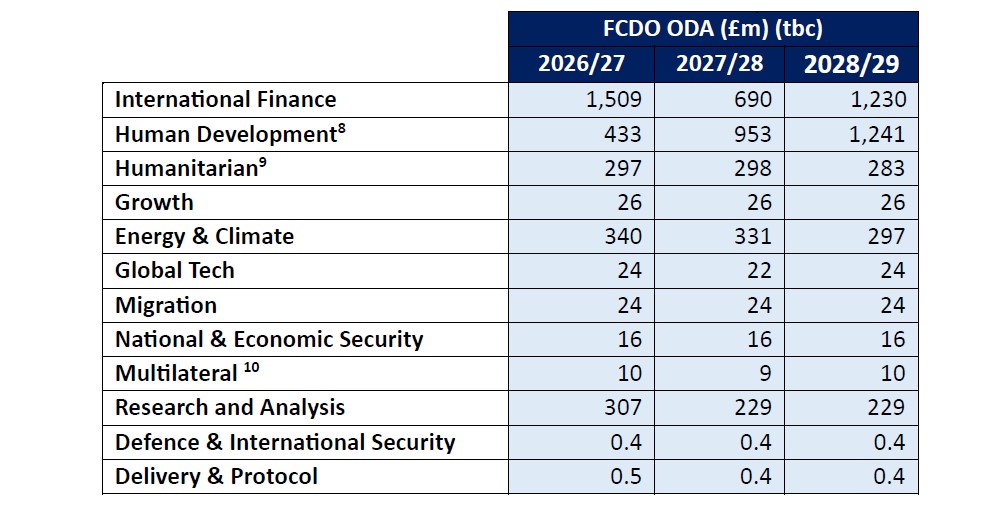 Source: FCDO
'No winners’, watchdog says
Sarah Champion, who chairs parliament’s International Development Committee, said there were “no winners” in the ODA allocations set out yesterday, “just different degrees of losers”.
She said that while the announcement provided a degree of certainty over the UK’s aid-spending plans, the overall picture was “desperately bleak” for some of the world’s most vulnerable people.
“IDC welcomes continued support for fragile and conflict affected states. But while the proportion of total ODA sent to these states increases, they are still facing around a 25% cut,” she said. “Meanwhile the outcome is devastating for non-FCAS countries which are facing a 60% cut. What’s more, regional programmes in Africa have been cut by £1.9bn over the next three years. By 2028-29, this will be a 50% cut. FCDO should urgently set out the exact financial impact for both FCAS and non-FCAS funding.”
Champion said the FCDO’s equalities impact assessment for the spending announcement showed it is likely to stop delivering ODA programmes with health objectives in Sierra Leone and Malawi.
“In Malawi, this would be expected to result in approximately 250,000 adolescents losing access to modern methods of family planning each year and an expected 20,000 children becoming at risk of dropping out of school because of an end to school feeding programmes,” she said.
‘Pace of change too rapid’
FCDO is currently expecting to reduce its headcount by up to 2,000 by the end of the decade. Against the backdrop of the department’s restructure, Champion described the pace of change as “too rapid” and likely to lead to the loss of key experts.
“The committee is especially concerned about the dangers of cutting experienced development staff who have built up vital relationships with country partners,” she said. “These staff provide exceptional value for money with relationships that enable us to successfully negotiate with ministers and deliver vital programmes."
Champion said the overarching decision to cut back on aid spending in favour of defence was a “false dichotomy”.
“If you ask any military person they will tell you the best line of prevention and first defence is our development money,” she said. “Because it keeps people safe and secure in their homes, it keeps them prosperous, it holds governments to account and I am very fearful in the world that we find ourselves that taking that first line of defence away is going to have massive consequences. These cuts do not aid our defence, they make the whole world more vulnerable.”
Elsewhere in yesterday’s announcement, FCDO confirmed that watchdog the Independent Commission for Aid Impact is being retained, but on a reduced budget.
Cooper confirmed that the government will increase ODA and non-ODA funding for the BBC World Service, providing an additional £11m a year for the next three years. The World Service is due to receive £86m in ODA funding next year.
The British Council is also being given a non-ODA uplift of £40m across the three-year spending review period.